
The A Minor Chord On The Piano – Charts & Fingering

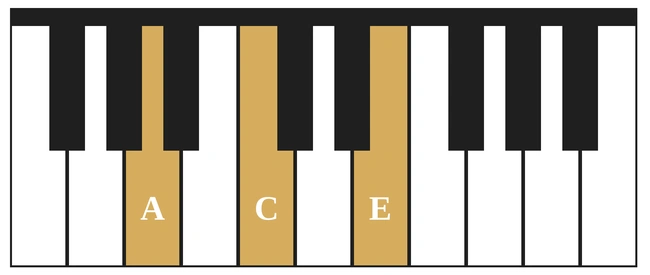
The A minor chord is the first minor chord most pianists learn. It uses only white keys and has a soft, gentle and slightly melancholic sound.
The A Minor piano chord (A – C – E) is made of three notes: A (the root), C (the third) and E (the fifth).
How the A Minor Chord Is Built
Every minor chord follows the same pattern: a minor third (3 half steps) from the root to the third, then a major third (4 half steps) from the third to the fifth. Count the half steps on the keyboard from A, and you will land on C and then E.
It is the home chord (i) of A minor and the vi chord of C major. It also appears as the ii chord of G major and the iii chord of F major, which makes it one of the most common chords in pop music. Its relative major is C major (C – E – G): the two chords share two notes, which is why they sound so good together.
How to Play the A Minor Chord on the Piano
A Minor Chord in Root Position
In root position, the notes are played from bottom to top: A – C – E.
For the right hand, place your thumb (1) on A, your middle finger (3) on C and your little finger (5) on E.
For the left hand, it is the reverse: your little finger (5) plays A, your middle finger (3) plays C and your thumb (1) plays E.
A Minor Chord Inversions
First Inversion
To play the first inversion (C – E – A), move the root A up an octave so that C becomes the lowest note.
Right hand: thumb (1) on C, index finger (2) on E and little finger (5) on A.
Left hand: little finger (5) on C, middle finger (3) on E and thumb (1) on A.
Second Inversion
For the second inversion (E – A – C), move E down an octave so that it becomes the lowest note.
Right hand: thumb (1) on E, middle finger (3) on A and little finger (5) on C.
Left hand: little finger (5) on E, index finger (2) on A and thumb (1) on C.
Practice Tips
- Play it slowly, hands separately, then hands together.
- Climb the inversions: play root position, first inversion and second inversion one after the other, up and then down the keyboard.
- Listen to the color: play the chord softly, then loudly, and notice how its character changes.
- Keep your hand round and relaxed, with your fingers curved and your wrist level.
Want to keep going? Discover the C major, G major, D major, F major and E minor chords, or the B diminished chord.
Learn Piano at La Maison
At La Maison, chords, harmony and ear training are part of every program, from our Made to Play group classes for ages 6 to 12 to private lessons for teens and adults in Never Too Late. Book a discovery visit to find the right program for you.
Contact Us
Address: 170 East 80th Street, New York, NY 10075
Website: www.lamaisonschoolofmusic.com
Email: info@lamaisonschoolofmusic.com
Instagram: @lamaisonschoolofmusic