
The C Major Chord On The Piano – Charts & Fingering

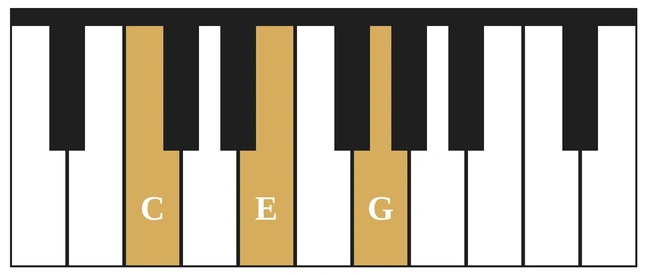
The C major chord is usually the very first chord pianists learn. It uses only white keys, sits right in the middle of the keyboard and sounds bright, stable and complete.
The C Major piano chord (C – E – G) is made of three notes: C (the root), E (the third) and G (the fifth).
How the C Major Chord Is Built
Every major chord follows the same pattern: a major third (4 half steps) from the root to the third, then a minor third (3 half steps) from the third to the fifth. Count the half steps on the keyboard from C, and you will land on E and then G.
It is the home chord (the I chord) of the key of C major. You will also meet it as the IV chord in G major and the V chord in F major, so it appears in countless pieces and songs. Its relative minor is A minor (A – C – E), which shares two of its three notes.
How to Play the C Major Chord on the Piano
C Major Chord in Root Position
In root position, the notes are played from bottom to top: C – E – G.
For the right hand, place your thumb (1) on C, your middle finger (3) on E and your little finger (5) on G.
For the left hand, it is the reverse: your little finger (5) plays C, your middle finger (3) plays E and your thumb (1) plays G.
C Major Chord Inversions
First Inversion
To play the first inversion (E – G – C), move the root C up an octave so that E becomes the lowest note.
Right hand: thumb (1) on E, index finger (2) on G and little finger (5) on C.
Left hand: little finger (5) on E, middle finger (3) on G and thumb (1) on C.
Second Inversion
For the second inversion (G – C – E), move G down an octave so that it becomes the lowest note.
Right hand: thumb (1) on G, middle finger (3) on C and little finger (5) on E.
Left hand: little finger (5) on G, index finger (2) on C and thumb (1) on E.
Practice Tips
- Play it slowly, hands separately, then hands together.
- Climb the inversions: play root position, first inversion and second inversion one after the other, up and then down the keyboard.
- Listen to the color: play the chord softly, then loudly, and notice how its character changes.
- Keep your hand round and relaxed, with your fingers curved and your wrist level.
Want to keep going? Discover the G major, D major, F major, A minor and E minor chords, or the B diminished chord.
Learn Piano at La Maison
At La Maison, chords, harmony and ear training are part of every program, from our Made to Play group classes for ages 6 to 12 to private lessons for teens and adults in Never Too Late. Book a discovery visit to find the right program for you.
Contact Us
Address: 170 East 80th Street, New York, NY 10075
Website: www.lamaisonschoolofmusic.com
Email: info@lamaisonschoolofmusic.com
Instagram: @lamaisonschoolofmusic